The Hunter 350 is the compact roadster interpretation of Royal Enfield’s air-oil-cooled 349cc platform. Its 17-inch wheels, 790mm seat and 1,370mm wheelbase distinguish it from the taller-wheeled Classic, while the current manufacturer table also lists a slip-assist clutch and USB-C charging.
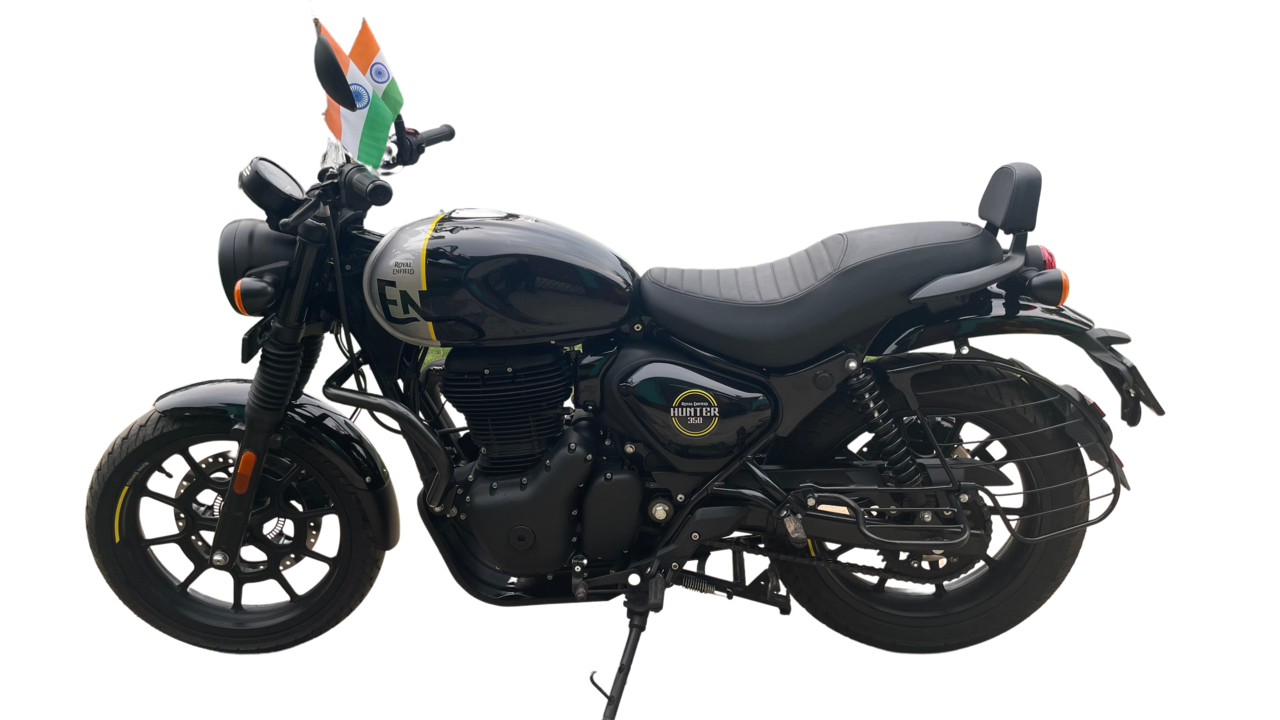

Current manufacturer listing; a new-launch date has not been independently verified for this article.
Technical specifications
| Engine | 349 cc, single-cylinder, air-oil cooled | ↗ |
|---|---|---|
| Power | 20.2 BHP at 6,100 rpm | ↗ |
| Torque | 27 Nm at 4,000 rpm | ↗ |
| Gearbox | 5-speed constant mesh | ↗ |
| Seat height | 790 mm | ↗ |
| Wheelbase | 1,370 mm | ↗ |
| Kerb weight | 181 kg with 90% fuel and oil | ↗ |
| Fuel tank | 13 L | ↗ |
| Ground clearance | 160 mm | ↗ |
| Front / rear tyres | 110/70-17 / 140/70-17; listed alloy-wheel configuration | ↗ |
| Front / rear brakes | 300 mm / 270 mm discs; dual-channel ABS in listed configuration | ↗ |
A roadster rather than a smaller cruiser
The Hunter’s dimensions tell a more useful story than its shared engine badge. A 1,370mm wheelbase, 17-inch wheels and 790mm seat place the rider in a compact package, but the quoted 181kg kerb mass remains substantial compared with a lightweight commuter. A shorter rider should therefore assess both foot reach and the effort needed to reverse into a parking bay. Seat height alone cannot establish whether the motorcycle feels manageable when the road slopes or a passenger climbs aboard.
The 349cc engine and five-speed character
Royal Enfield quotes 20.2BHP at 6,100rpm and 27Nm at 4,000rpm for the Hunter. The torque peak occurring below the power peak helps explain why the engine is intended to work through a broad everyday rev range rather than depend entirely on high revs. Its five-speed gearbox and current assist-and-slip clutch specification should be assessed together in traffic. The clutch mechanism can change lever behaviour, but it does not remove the rider’s responsibility for clean shifts or make the motorcycle an automatic.
Wheels, suspension and road surfaces
The listed alloy-wheel version pairs a 110/70 front tyre with a wider 140/70 rear tyre, both on 17-inch rims. Those dimensions differ from the larger front wheels used on several other Royal Enfield models, so tyre replacements must follow the Hunter’s own specification. A 41mm telescopic fork works with twin rear shocks offering six preload settings. Preload adjustment can accommodate load changes within the manufacturer’s limits; it is not a substitute for correct tyre pressure, nor does it turn a roadster into a long-travel adventure motorcycle.
Braking equipment needs a variant check
The current technical table describes a 300mm front disc, a 270mm rear disc and dual-channel ABS. Treat that as the described configuration and confirm it on the actual invoice, especially when comparing older stock or differently equipped versions. ABS manages wheel-lock risk under braking; it cannot cancel poor grip, excessive speed or an unsuitable following distance. During delivery, have the dealer explain the warning-lamp sequence and the owner-manual checks instead of assuming that every Hunter previously sold carried the same braking hardware.
The cockpit’s practical upgrades
The manufacturer lists an LED headlamp and tail lamp, a digi-analogue instrument cluster and a Type-C fast-charging port. These features improve the information and device-charging options available to the rider, but the equipment list should not be confused with a full smartphone replacement. Check whether a navigation pod is included in the particular quotation, how its phone connection works and where a charging cable can be routed safely. A dashboard photograph may show accessories that are separate from the selected factory variant.
Where the Hunter fits in ownership
A 13-litre tank and 160mm published ground clearance are useful planning figures, not promises about distance between refills or clearance over every speed breaker. The Hunter deserves a demonstration on the owner’s actual commuting route, with attention to low-speed balance, seat comfort and passenger accommodation. Compare the final quote using the same wheel and braking specification, then separate registration, insurance and optional accessories. This article does not supply an invented mileage result or a universal state-wise on-road price; both require evidence specific to the rider and quotation.
Features and equipment
- Assist-and-slip clutch in current listing
- Type-C fast charger
- 17-inch alloy-wheel configuration
Strengths and points to check
Strengths
- Compact wheelbase and moderate seat height
- Documented dual-channel ABS configuration
Considerations
- 181kg remains significant in parking
- Equipment differs across stock and variants
Editorial interpretation of published specifications, not a hands-on road test.
Variants, price and state-wise quotation
| Variant / configuration | Price context |
|---|---|
| Hunter 350 | — Exact colour, wheel and equipment quotation required; a current city-specific price was not verified. · ↗ |
State-wise ex-showroom and on-road quotes are not verified for this model. The amount can depend on city, variant, insurance and registration. Select your state in the calculator and enter an itemised local quotation; no automatic tax rate or subsidy is assumed.
Sources and editorial notes
Specifications are manufacturer claims and may differ by trim. Published information can change; confirm the exact vehicle before making a decision.
Information still to verify
- Verified variant-by-variant state and city prices
- Licensed photograph matching the specific current variant
- Independent real-world fuel economy and road-test results